Showing posts with label Ceremony. Show all posts
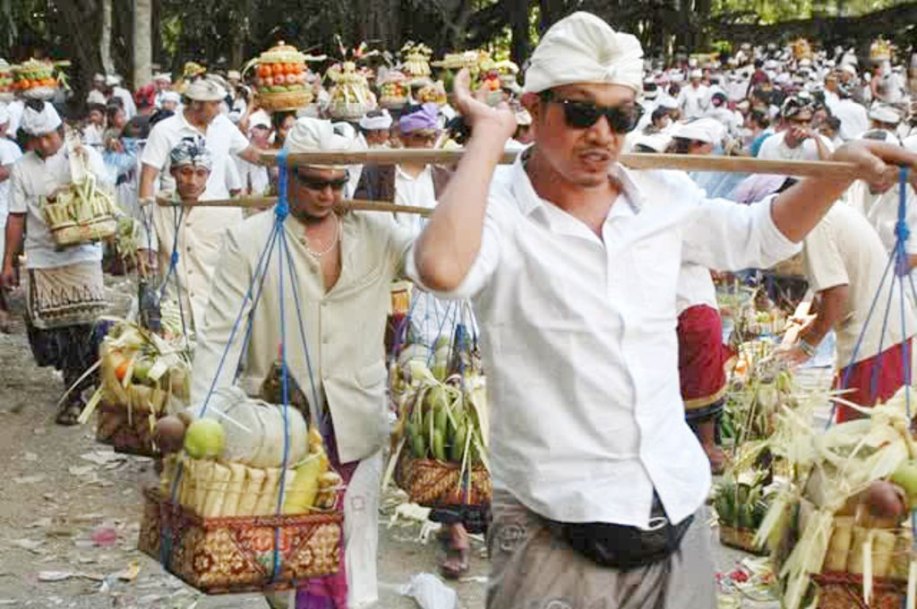
In preserving the customs and culture, thousands of people of Kedisan, Kintamani, held a unique ritual named ngusaba tegen. In contrast to the ceremony in general, the ingredients used in the ngusaba tegen ritual was cake or fish that should be boiled or grilled.

Thousands of people were walking side by side while bringing the ritual paraphernalia in the form of offerings. Male residents carried the offerings of tegen-tegenan on carrying pole, while women carried an offering named gebogan. They left the village for the local Dalem Praja Pati Temple, the venue of ngusaba tegen ritual.

According to Chief of Kedisan Customary Village, it was an ancient tradition of rural society of Kedisan as expressed in Shiva Purana palm-leaf manuscript. Actually, it had been carried out for generations since the Kedisan Village was established.

Content of this tegenan offering included a variety of agricultural products such as vegetables, fruits, fish and others. All items in the contents of carrying oblation consisted of twenty pieces. These carrying oblations would be presented by all men living at Kedisan Village. However, it was not allowed to use fried cake or fish. Instead, the cakes or fish should be grilled or steamed.

Other uniqueness of usabha tegen procession was the implementation of census tradition throughout the community by collection of perforated coins. The census was intended to get the amount of the entire Kedisan Village community. Then, the perforated coins obtained from the census were backfilled in the courtyard of the local temple. It was intended to inform the deity abiding in the Dalem Temple about the total number of local community. Based on the amount of coins collected, it was then known the number of Kedisan villagers, namely 2,992.

Usabha tegen ritual was held annually in the third month of Balinese calendar falling around August or September.
Read More >>
Pagerwesi Day, which falls on Wednesday, Buda Kliwon Sinta (Balinese Calendar), is the third most celebrated holidays in Bali after Galungan and Nyepi Day. Balinese Hindus celebrate Pagerwesi every six months (210 days) according to the pawukon calendar systems. Pagerwesi derived from words “pager (fence)” and “wesi (iron)”, simply “iron fence”, is a day to strengthen one’s fortification against evil.

Pagerwesi is dedicated to honour Siva, the God manifestation as Hyang Pramesi Guru (the main Guru), and has a very close relationship with Saraswati day. It falls three days after Saraswati day, and there’s continuity meaning between them. In Pagerwesi people honour the main Guru (God or Siva) that transferred knowledge during Saraswati day. It also means that the knowledge must be protected from bad influences and misuse.

If we are looking back to the roots of Hinduism in Bali, which was originated from India, there is a similar ceremony called Guru Puja or Guru Purnima. The Indians, however, celebrate it in a very different way and day. They celebrate Guru Puja on Purnama Kasa or the first new moon every year. Pagerwesi reminds human to be wise and more aware to the function and power of knowledge.

During pagerwesi, Balinese held Tapa Brata (Semadhi) to refresh and calming their mind, at this day also will held a ritual procession with pray at nearest temple. If able Balinese people will held the pray at big temple like Besakih or Jagatnata, but if they was unable because must work or do some other job, the pray can be held on the night on their own home temple. Some people meaning this day by it’s name Pagerwesi (Pager = fence, Wesi = iron), known as the day to protect ourself from all negative element, by semadhi and pray to the god to refresh the mind.

Read More >>
Galungan Day is one of the Hinduism biggest ceremony in Bali which is celebrated in every six month according to the Balinese calendar. At the Galungan Day the Balinese celebrate the victory of the good conquered the bad.

In every villages in Bali, we can easily find line of decorated bamboo pool called “Penjor” which plated and stand beautifully in front of each houses. In the morning at that day, there are women, men and children all in Balinese traditional dress walk on the street to go to their temple. The women bring offering called “Pajegan” contains of different and colorful fruits, cakes, coconut leaf and flowers which is arranged in a stack about 1 meter high and  put on  their head. When they arrived in the temple, they will pray together lead by the Hindu’s Priest called “Pemangku”.

After finishing they will go back to their own home and to gather with all members of extended family. The members of family and friends who are Moslem, Buddhist and Christian will pay a visit to their Hindus family and together will enjoy Balinese cookies.

Here are the activities related to Galungan Day in Bali:

  • Three day before Galungan Day, the men set up the equipment associated with Galungan Ceremony such as bamboo, young coconut leaves and various kinds of flowers, material for making offering, while the women prepare various kinds of fruits.

  • Two days before Galungan Day, the men decorate the family temple with white and yellow cloths which means the symbol of purity, and black white cloths (looks like chess board colors) which means the symbol of harmony, while the women very busy make various kinds of cakes for offering.
  • A day before Galungan Day, early morning the men join with their neighbors to slaughter a pig, than cook any types of Balinese dishes: lawar, komoh, serapah, kuwah balung, sate lilit, jukut ares, tum bungkil (I will write about these kind of Balinese dishes on other occasions) and grill some chickens for the offering, at noon the men make a long bamboo pole or “Penjor” to decorate the entrance of family compound. By late afternoon a day before Galungan Day, all over Bali decorated by penjor creating a very festive atmosphere in the street. While the women of the household have been busy for days creating beautifully woven ‘banten’ (offerings made from young coconut leaves),
  • On Wednesday, the day of Galungan Day, all part of family pray at family temples and other village temples. On this special day most Balinese will try to return to their own making offeringancestral home at some stage during the day, even if they work in another part of the island. This is a very special day for families, where offerings are made to God and to the family ancestors who have come back to rest at this time in their family temple. As well as the family temple, visits are made to the village temple with offerings as well, and to the homes of other families who may have helped the family in some way over the past six months

    A day after Galungan Day, is a time for a holiday, visiting friends, picnic to beach or just chilling with family, and be ready to welcome the Kuningan Day in the next nine days.


Visit my Web Gallery to see more pictures about Bali and other Photo Gallery JPEG Photography, Bali Photographer
Read More >>