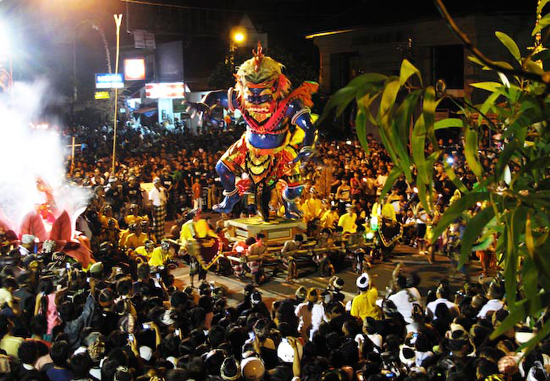
In preserving the customs and culture, thousands of people of Kedisan, Kintamani, held a unique ritual named ngusaba tegen. In contrast to the ceremony in general, the ingredients used in the ngusaba tegen ritual was cake or fish that should be boiled or grilled.

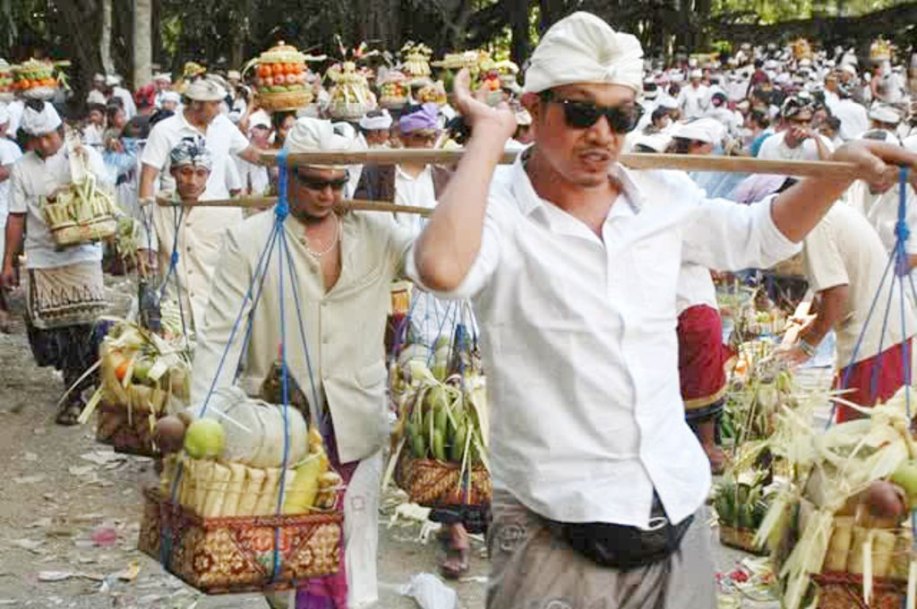
Thousands of people were walking side by side while bringing the ritual paraphernalia in the form of offerings. Male residents carried the offerings of tegen-tegenan on carrying pole, while women carried an offering named gebogan. They left the village for the local Dalem Praja Pati Temple, the venue of ngusaba tegen ritual.

According to Chief of Kedisan Customary Village, it was an ancient tradition of rural society of Kedisan as expressed in Shiva Purana palm-leaf manuscript. Actually, it had been carried out for generations since the Kedisan Village was established.

Content of this tegenan offering included a variety of agricultural products such as vegetables, fruits, fish and others. All items in the contents of carrying oblation consisted of twenty pieces. These carrying oblations would be presented by all men living at Kedisan Village. However, it was not allowed to use fried cake or fish. Instead, the cakes or fish should be grilled or steamed.

Other uniqueness of usabha tegen procession was the implementation of census tradition throughout the community by collection of perforated coins. The census was intended to get the amount of the entire Kedisan Village community. Then, the perforated coins obtained from the census were backfilled in the courtyard of the local temple. It was intended to inform the deity abiding in the Dalem Temple about the total number of local community. Based on the amount of coins collected, it was then known the number of Kedisan villagers, namely 2,992.

Usabha tegen ritual was held annually in the third month of Balinese calendar falling around August or September.
Read More >>
A team from UNESCO will visit locations in Bali next month as part of a final assessment for a potential world cultural heritage nomination, a Bali Culture Agency official says.

“The teams are scheduled to be in Bali Oct. 12-17,” agency head Ketut Suastika said on Saturday in Denpasar as quoted by Antara news wire.

Suastika said that three locations had been nominated as potential world cultural heritage sites, namely Pakerisan water catchment area in Gianyar, the rice paddy field area in Jatiluwih, Tabanan and the Taman Ayun temple in Badung.

“We have been intensively renovating those locations, and especially inviting the local community commitment to support the assessment process,” he said.

The results of the visit will be shared and discussed during the UNESCO assembly in June next year.

The Jakarta Post
Read More >>
South Bali is to get a new 11-kilometre toll road as part of efforts to ease chronic congestion.

A new consortium has been formed to fund and run the Rp2.4-trillion (US$280-million) project, with work expected to begin later this year, it was revealed this week.

The Bali Tourism Development Corporation (BTDC), a government-owned tourism company which manages the Nusa Dua resort area, will be responsible for the project, which will connect Nusa Dua, Benoa and Ngurah Rai International Airport.

“This project will address the severe traffic jams we are experiencing right now,” BTDC operational director I Nyoman Cakra told reporters. “The toll road will provide a better and more convenient route for tourists.”

Cakra said that as well as improving current conditions, the new road would allow for further growth of tourism in Bali.

A construction consortium to invest in the project was founded in August, featuring seven state-owned investors. BTDC will contribute just 1 percent of the funding. Principal investors include PT Jasa Marga, the company which runs most of Indonesia’s existing toll-road concessions and which is contributing 60 percent of the funding; Pelindo III, which runs Benoa Harbour and which will add 20 percent funding to the total; and PT Angkasa Pura, which runs Bali’s airport, and which will contribute 10 percent.

Construction will begin in October, and is planned to be complete by April 2013, ahead of an APEC conference.

Meanwhile, the Bali Environmental Agency announced that it had not received any notification from the developers about the project, and stressed that an environmental impact assessment needed to be carried out before work began. The route of the new road will pass through the mangrove forests on the southeast coast of Bali.

“The document should be submitted to the head of the Environmental Agency prior to the commencement of any construction stage of the project. So far we have yet to receive such documentation,” said agency head I Komang Ardana.

Initial announcement of the plan was made in January. The road will link Serangan, otherwise known as Turtle Island, to the main port area at Benoa, and from there to the airport and Nusa Dua, relieving pressure on the current main highway, Jl Bypass Ngurah Rai, which is scene of some of Bali’s worst congestion, especially around the Dewa Ruci intersection on the outskirts of Kuta.
Read More >>
Bali is an island filled with unique traditions, arts, cultures, and beautiful performances. Dances, play, songs and traditional music performances found in Bali have so many variations. One of the singing performances is kekawin. It is a traditional Bali singing performance and the lyrics are taken from holy Hindu books. We can say that kekawin is like a choir in the church but the difference is that the song lyrics are the holy spells (sentences) written in the Hindu bibles like Sarasamuccaya, Bhagawadghita, and epic stories like Ramayana and Mahabharata. Usually, it is performed during religious ceremonies, kekawin contests, and broadcasted on TV stations.

The group of people who sing kekawin is called Peshantian. Nowadays, there are not many Peshantian here in Bali. It is because kekawin is mainly sung by senior people. The youth seems to be uninterested in singing kekawin. Peshantian is a place to learn and comprehend aksara (Bali letters) in the Hindu bibles and then sing it. Kekawin is written in Latin and Bali letters. It is a little bit difficult to sing it because there is specific pitch, rhymes and intonation in singing kekawin Maybe; it is a reason why Bali young generation doesn’t want to learn it. There are two important persons in Peshantian group when the group sings kekawin. The first person is called Pewirama or the singer. She or he sings kekawin with appropriate rhymes, pitch, and intonation. The second person is called Peneges. He or she is the person who gives meaning or explains the sentence that pewirama sings. So, every time pewirama finishes his or her sentence (idyll), peneges then describes the meaning to the audience in the way of a story teller tells his story. After that, pewirama continues his or her part of sentence and then pewirama describes the meaning again. They do it until kekawin is finished. Before they start and after they finish the kekawin, they always say the Hindu greetings, Om Swastyastu and Om Shanti Shanti Shanti Om.

There is a Peshantian group in Buleleng called Sekaa Shanti Dharma Sraya. The founder of this Peshantian group is Jero Mangku Ketut Kariawan. He gathered about 24 people in the year of 2000 to be members of Peshantian Sekaa Shanti Dharma Sraya. The members of Sekaa Shanti Dharma Sraya are the villagers of Kedis Village in BusungBiu sub district. They are middle aged men and women and they have great ability in singing and comprehending kekawin. Jero Mangku Ketut Kariawan’s purpose in gathering the villagers of Kedis village into a Peshantian group was to preserve kekawin. The group often performes on local TV stations in Bali. They also have won many awards in Peshantian contests conducted by the government culture and tourism board.

Moreover, there are many valuable moral values in kekawin that can teach us the meaning and the purpose of our lives. The stories taken in kekawin are stories of Ramayana and Mahabharata like the stories of Arjuna Wiwaa, Karnantaka, and etc. The stories consist of morals, etiquette, kindness, heroism, bravery, honesty, and reality.

Therefore, Jero Mangku Ketut Kariawan hopes that the young generation will have more interest in joining peshantian. The young generation in this era seems to be careless about this traditional music art inherited from the ancestors. They should preserve this art because if they don’t, who else? At least by joining peshantian the young generation can show their gratitude to their ancestors and moreover, they can learn many precious things in peshantian. Although singing kekawin is not an easy thing, but through persistance, Jero Mangku Ketut Kariawan believes they can do it.
Read More >>
Balinese traditional cakes remain to have its market share amidst the proliferation of diverse modern snacks today. It is evident, though only relying on the sales in traditional markets, the transaction is this kaliadrem cake can compete against modern type of cakes offered by a number of bakeries and supermarkets.

“So far, the kaliadrem is still in high demand. However, the volume tends to fluctuate. In other words, sometimes many people came to purchase the cakes, while on the other occasion we could not make a single sale per day,” said Nyoman Suantari, one of the traditional cake sellers. The sale of kaliadrem, a traditional snack made of rice flour, was no less competitive against the other more modern cakes.

This traditional cake can survive because it is not only targeted for the content of oblations during the Galungan and Kuningan festivity. Lately, the snack with a savory and sweet flavor is also taken advantage by many people as accompaniment of drinking tea or coffee in the afternoon.

Suantari explained the enthusiasts of traditional snacks like kaliadrem would certainly favor it. Kaliadrem itself was sold with a variety of forms ranging from a round mini donut to triangular. Both forms were characterized by a hole in the center of the donut. The number of hole varied from one to three pieces. The cake was made from simple ingredients like rice flour, brown sugar, coconut, salt and water. It was made in a very long time about 5-8 hours because it was still using a traditional method, directly made from rice grounded into flour. This method was intended to keep the original flavor of the cake.

Another cake seller revealed that kaliadrem remained in high demands in the market today. It was not only due to its cheap price, but also due to sweet taste fitting with local appetite. Moreover, the surface of the cake was sprinkled with sesame seeds that caused it increasingly mouthwatering
Read More >>
A team of marine biologists from Conservation International have described eight new species of tropical reef fish and a new species of coral in the waters surrounding Bali.

“We have carried out a marine survey in 33 sites around Bali island and have identified 952 reef fish, and among them we discovered eight new species,” said the team’s senior adviser, Mark Van Nydeck Erdmann.


The group of scientists was conducting a survey of 33 diving sites around the island and logged 350 hours of diving. The team included what many consider top experts in their respected fields. The group categorized the sites as designated marine areas, which should be protected due to the abundance of biodiversity found in those sites.
“Eight of the 952 species have never been found anywhere else in the world,” Erdmann said.

Included in the new discovery are a species of cardinal fish in the genus Siphamia, a congrid eel in the genus Heteroconger found in Pemuteran 7-10 meters underwater. A new species of combtooth blenny in Gilimanuk and sandperch in Nusa Dua were also described for the first time.

They also were able to discover a new species of goby and dottyback in the genus Grallenia and Manonichthys respectively off the coast of Tulamben. The scientists were also able to identify new deeper water species in Candidasa with a type of cardinal fish in the genus Apogon at 70 meters below the surface and a dottyback at 20 meters.

The team was also able to identify 393 coral species and discovered two new corals previously unknown to science. The new corals represented the genus Euphyllia and Isopora found at a depth of 40 meters around Padangbai and Amed.

“For Euphyllia sp., we are pretty sure that it is a new species,” Erdmann said, adding that Euphyllias are a genus of bubble coral. “Globally, there are eight species of bubble coral. The one we found in Padangbai is different from the eight species. This is the ninth one,” he said.

All the new species have yet to be named and formally entered into taxonomical record.

Read More >>
Pagerwesi Day, which falls on Wednesday, Buda Kliwon Sinta (Balinese Calendar), is the third most celebrated holidays in Bali after Galungan and Nyepi Day. Balinese Hindus celebrate Pagerwesi every six months (210 days) according to the pawukon calendar systems. Pagerwesi derived from words “pager (fence)” and “wesi (iron)”, simply “iron fence”, is a day to strengthen one’s fortification against evil.

Pagerwesi is dedicated to honour Siva, the God manifestation as Hyang Pramesi Guru (the main Guru), and has a very close relationship with Saraswati day. It falls three days after Saraswati day, and there’s continuity meaning between them. In Pagerwesi people honour the main Guru (God or Siva) that transferred knowledge during Saraswati day. It also means that the knowledge must be protected from bad influences and misuse.

If we are looking back to the roots of Hinduism in Bali, which was originated from India, there is a similar ceremony called Guru Puja or Guru Purnima. The Indians, however, celebrate it in a very different way and day. They celebrate Guru Puja on Purnama Kasa or the first new moon every year. Pagerwesi reminds human to be wise and more aware to the function and power of knowledge.

During pagerwesi, Balinese held Tapa Brata (Semadhi) to refresh and calming their mind, at this day also will held a ritual procession with pray at nearest temple. If able Balinese people will held the pray at big temple like Besakih or Jagatnata, but if they was unable because must work or do some other job, the pray can be held on the night on their own home temple. Some people meaning this day by it’s name Pagerwesi (Pager = fence, Wesi = iron), known as the day to protect ourself from all negative element, by semadhi and pray to the god to refresh the mind.

Read More >>